
Trade with a process, not a hunch.
Free cTrader indicators, plain-English guides and AI-assisted trading tutorials, built by a trader with almost 20 years in the forex industry.
Tools you can see on your chart
Custom cTrader indicators that mark sessions, gaps and sweeps using written rules, so you study price instead of guessing at it.
Guides that explain the “why”
Every guide shows the rule, the risk and the honest limits, including when the setup should be skipped entirely.
AI that does the clicking
Connect Claude to cTrader and run routine platform tasks by talking to it. Set it up on demo first, step by step.
Custom indicators, built around written rules
Each indicator marks what a set of rules says, and none of them place trades or give signals. Downloads are being finalised, so join the free list and you'll get each one the moment it's ready.
New York Open
Measure the opening 15-minute candle, run three go/no-go gates, and see every level on your chart.
Read the guideFair Value Gap
Marks three-candle gaps, applies four written checks, and colours each by what price did next.
Read the guideLiquidity Sweeps
Tracks swing highs and lows, flags sweeps that close back inside, and follows them to confirmed or failed.
Read the guideSession Map
Draws Asian, London and New York boxes with each session’s high, low and range in daily ATR.
Read the guideGet told the day something new goes live
One mailer covers trading guides, indicators, bots, broker reviews and special deals. You can leave whenever you like.
- Trading guides and new video lessons
- Indicators and bots as each one is released
- Broker reviews and special deals when they're running
I let AI control my cTrader account
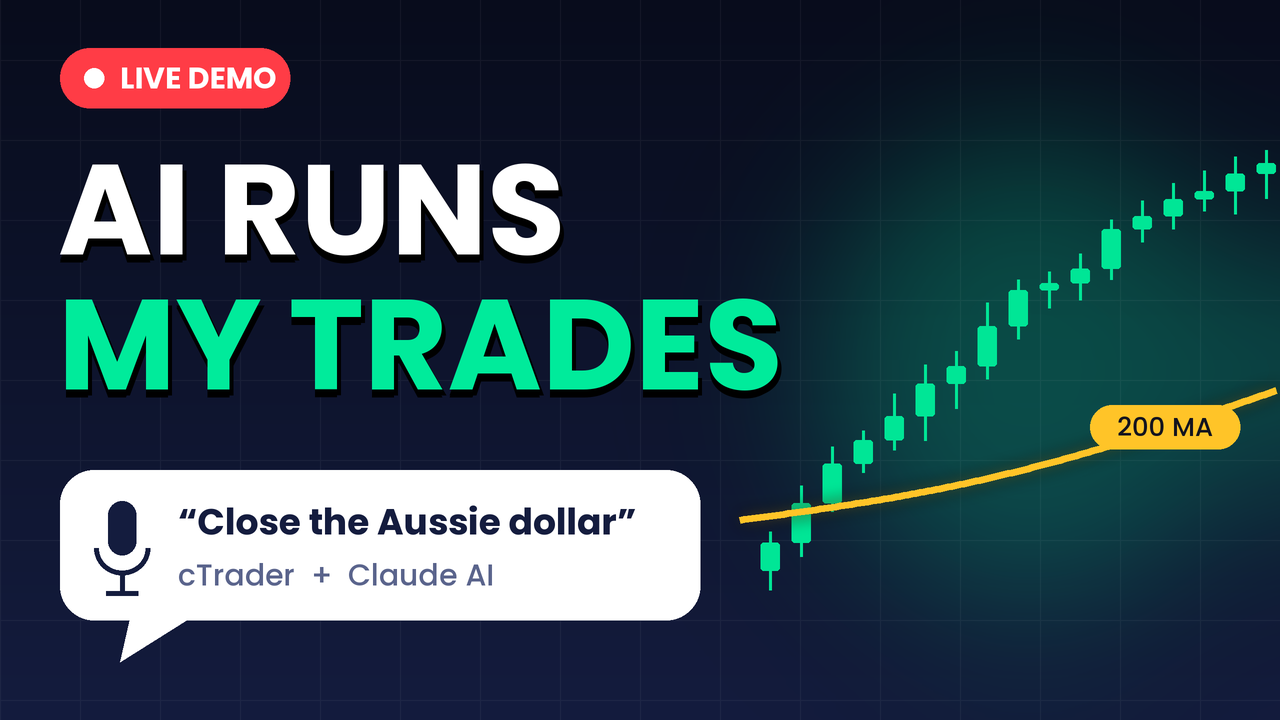
A short, no-edit demo of Claude opening charts, ranking open trades, adding a 200 MA and moving a stop loss, all by simply talking.
- Voice and text instead of clicking through menus
- Works with cTrader’s built-in MCP server, set up in about ten minutes
- Demo account first, with confirmation switched on
The Way I Trade, in 21 modules
A step-by-step path from how the market works through to full strategies and your own trading plan. The modules are in production, and the topics below are what each one covers.
Foundations
- 1Welcome, how to use the course, and risk
- 2How the forex market works
- 3Currencies, pairs, gold and indices
- 4Sessions: when the market moves
- 5Quotes, pips, lots, leverage and margin
- +2 more
Reading the chart
- 8Candlesticks and the pattern cheat sheet
- 9Indicators: MA, Bollinger, MACD, RSI, Stochastic, ADX
- 10Price levels and structure
Classic strategies
- 11Cowabunga
- 12Simple Scalper
- 13Pivots and Candles
- 14Price action: pin bars, engulfing, pending orders
- 15Elliott Wave
The TWIT strategies
- 16The New York Open
- 17Fair Value Gaps
- 18Liquidity Sweeps
- 19Trading Sessions
- 20Your trading plan and journal
- +1 more
Start learning today, no sign-up needed
Three short lessons on the things that decide whether you stay in the game: how your broker handles your orders, how much to risk, and how to read price.
A-book, B-book and why it matters to you
6 min read
How your broker handles your order decides whose interests are aligned with yours.
Two ways a broker can handle your order
With an agency (often called A-book, STP or ECN) model, the broker passes your order to liquidity providers and earns from commission or a markup on the spread. With a dealing-desk (B-book) model, the broker takes the other side of your trade, so your loss can be its gain.
Why this is a conflict of interest, not a scandal
B-book is legal in many jurisdictions and not automatically abusive. But it means the broker benefits when clients lose, so you should understand the incentives, and look for disclosure in the broker's order execution policy.
What to check before funding any account
Read the execution policy. Confirm the regulator on the regulator's own register, not the broker's homepage. Look at the typical spread plus commission, not just the headline spread. Test with a demo, then a small live balance. Withdraw a small amount early to see how it works.
Honest caveat
Marketing claims such as '100% A-book' are hard for a client to verify. Treat them as claims to question, and ask for written confirmation.
Education only, not financial advice. Forex and CFDs carry a high risk of loss.
Position sizing: the maths that keeps you in the game
8 min read
A worked example of risking a fixed percentage per trade.
Start with the loss, not the profit
Decide the maximum you will lose on one trade before you look at the target. Many educators suggest a small fixed fraction of the account, commonly between 0.5% and 2%. It is a guideline for survival, not a promise of profit.
The formula
Lot size = (account balance x risk %) / (stop distance in pips x value per pip per lot). The stop distance comes from the chart, for example beyond a recent swing point, never from the lot size you wish you could trade.
Worked example
Balance 2,000 USD, risk 1% = 20 USD. EURUSD stop 25 pips. One pip on one standard lot is about 10 USD, so 25 pips is 250 USD per lot. Lot size = 20 / 250 = 0.08 lots. If the stop is hit you lose roughly 20 USD, plus spread and slippage.
Drawdown arithmetic
Losing 10% needs an 11.1% gain to recover. Losing 50% needs 100%. This asymmetry is why oversized positions end more accounts than bad analysis does.
Education only, not financial advice. Forex and CFDs carry a high risk of loss.
Reading price action: structure before indicators
7 min read
Swing highs and lows, levels and context, in plain language.
Market structure
An uptrend is a sequence of higher highs and higher lows; a downtrend is the reverse. A break of the last significant swing low in an uptrend is a warning, not a command.
Levels
Areas where price has reacted more than once are worth marking. Think of them as zones with width, not exact lines. Higher timeframe levels carry more weight than lower ones.
Candles as context
A long wick at a level shows rejection happened there. It is information about the past few minutes, not a forecast. Combine it with structure and with a pre-defined stop.
Build a written checklist
Trend direction on the higher timeframe. Nearby level. Trigger. Stop location. Position size. Reason to stand aside. If you cannot fill every line, you have no trade.
Education only, not financial advice. Forex and CFDs carry a high risk of loss.
Brokers we're happy to work with
We've partnered with Egoli Forex and PrimeXBT and are reviewing others. We don't support brokers who don't pay their clients. Before accepting a partnership we search for complaints and confirm whether they're valid.
| Broker | Platforms | Execution | Regulation | Spreads |
|---|---|---|---|---|
| Egoli Forex ↗ Featured partner | cTrader | Pure STP/ECN | FSP 49015 | From 0.1 pips |
| PrimeXBT ↗ | MT5 and PXTrader | Not provided | FSP 45697 | Not provided |
Affiliate disclosure: Egoli Forex and PrimeXBT are TWIT partners and we may earn a commission from partner referrals. This doesn't change what we teach. Spreads vary by instrument, account and market conditions. Always confirm a broker's regulation on the regulator's own register.
Interested in small-group mentorship?
Mentorship isn't open yet. Register your interest and you'll hear first about format, availability and cost. It will focus on process, review and risk, not on copying trades.